Finding a great tennis partner really boils down to three things: knowing what you want, knowing where to look, and making a good impression when you finally hit the court. The fastest way to get started is by taking a minute to be honest with yourself about your game and what you’re really looking for.
Know What You Are Looking For in a Partner

Before you even think about posting in a Facebook group or downloading an app, the most important step is to figure out who you actually want to play with. This goes way beyond just matching skill levels. Getting clear on your own goals will save you from countless frustrating matches with people who just aren't the right fit.
Start with a realistic look at your ability. It's tempting to round up, but a brutally honest assessment is your best friend here. If you have an official NTRP rating, perfect. If not, check out the USTA’s guidelines and see where you genuinely land. Are you a 3.0 who can keep a rally going but struggles with consistency, or are you a 4.0 who hits with depth and variety? Honesty is non-negotiable.
Define Your On-Court Goals
Next up, think about why you want to play. Your reason for getting on the court directly shapes the kind of partner you should be looking for. Everyone has a different motive, and finding someone whose goals align with yours is the secret sauce to a great tennis partnership.
Do any of these sound like you?
- The Competitor: You live for intense, competitive sets. You want to keep score, play to win, and push yourself. Your ideal partner thrives on pressure and is all about match play.
- The Social Rallier: You're just looking for a fun, friendly hit to unwind and get some exercise. For you, the chat between points is just as important as the rally itself.
- The Skill Builder: Your main mission is improvement. You're the one who wants to drill that slice backhand or work on your second serve for an hour straight.
The biggest mistake I see players make is not clarifying expectations upfront. A player looking for a casual rally will get burned out by someone who wants to play a tiebreak every set, and vice versa. A little clarity from the start prevents a lot of mismatched frustration later.
To help you out, here’s a quick guide to matching your goals with the right kind of partner.
Matching Your Goals to Partner Types
| Your Tennis Goal | Ideal Partner Profile | Best Places to Look |
|---|---|---|
| Improve My Game | Someone slightly better than you who enjoys drilling and practice sessions. Often a fellow "Skill Builder." | Club clinics, private lesson groups, find-a-partner boards at your local club. |
| Play Competitively | A player at your exact skill level (or slightly above) who loves match play and wants to join leagues or tournaments. | Club ladders, USTA league rosters, competitive "match play" events. |
| Have Fun & Exercise | A person with a similar skill level and a relaxed attitude. Reliability is more important than a killer serve. | Social mixers, community tennis groups on Facebook, apps like PlayYourCourt. |
| Find a Doubles Partner | Someone whose playing style complements yours (e.g., a strong net player if you're a solid baseliner). | "Find a Doubles Partner" events, team practice sessions, asking club pros for recommendations. |
Think of this table as your cheat sheet for narrowing down your search before you even start looking.
Align Your Availability and Preferences
Finally, let's get down to the practical stuff. How often can you realistically get on the court? Are you an early bird, or do you prefer hitting under the lights? Do you belong to a club, or are you a public court warrior?
For example, if you can only play on Tuesday mornings, you should be targeting players with similar weekday flexibility—think retirees, freelancers, or remote workers. If you only want to play doubles, make that crystal clear from the get-go. This simple self-assessment creates a solid profile of your ideal partner, making your search way more focused and, ultimately, more successful.
Using Apps and Online Groups to Connect
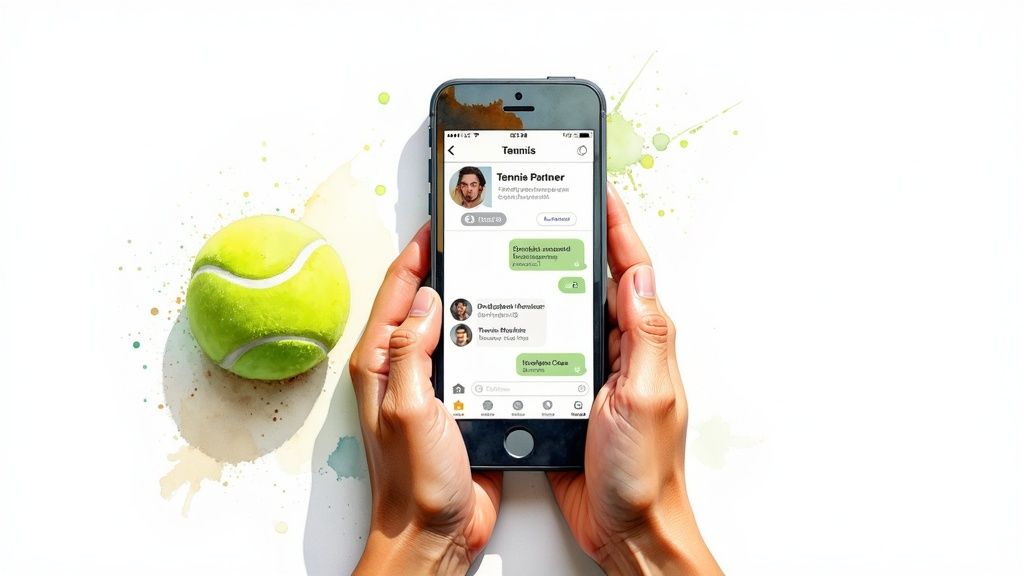
Let's face it, your next great hitting partner is probably scrolling on their phone right now. Forget the dusty old bulletin board at the club—digital platforms have blown the doors wide open for finding matches. These tools connect you with a massive pool of local players, making it easier than ever to find a tennis partner who actually fits your schedule and skill level.
And that pool of players is getting bigger by the day. A recent ITF Global Tennis Report found that participation has jumped to over 106 million people worldwide. That's a staggering 25.6% increase in just five years. More players means more opportunities, dramatically boosting your odds of finding that perfect match.
Crafting a Winning Player Profile
Think of your online profile as your digital handshake. It’s your first—and often only—chance to make a good impression. A solid profile does more than just state your NTRP rating; it tells a story about the kind of person you are on the court. To attract the right players, you need to be specific.
Here’s how to build a profile that actually works:
- Be Honest About Your Skill Level: State your NTRP rating. If you're self-rated, just say so and add a little color. Something like, "Solid 3.5 who can hold a rally, but my second serve is definitely a work in progress." It sets realistic expectations right away.
- Detail Your Playing Style: Are you a competitive baseliner who grinds out every point, or more of a fast-paced serve-and-volley player? Mentioning this helps attract people who enjoy the same kind of game.
- Specify Your Goals: Are you training for a league? Just looking for a casual weekend hit? Or maybe you need a partner to drill with? Stating your goal filters out the mismatches from the get-go.
A great profile cuts right to the chase: "NTRP 4.0 looking for competitive singles matches on weeknights after 6 PM. Training for the upcoming USTA league season and enjoy an all-court game. Also open to drilling on weekends."
That one little paragraph tells potential partners everything they need to know, saving everyone a ton of time.
Dedicated apps like TennisPAL are built for this, letting you filter players by skill, distance, and availability.
As you can see, the player cards give you a quick snapshot—rating, bio, availability—making your search incredibly efficient.
Leveraging Social Media and Niche Platforms
Don't just stick to the dedicated tennis apps. The real gold is often found in community-driven platforms. Local Facebook groups and Reddit communities (like the r/tennis subreddit) are fantastic places to connect with players in your area.
When you post in these groups, be direct. Lay out all the key info in your first post to skip the endless back-and-forth messages. Include your location, skill level, what you're looking for (singles, doubles, drills), and when you're generally free. It’s a simple sign of respect for other people's time.
And if you’re organizing group hits or a friendly competition, knowing how to create a tournament bracket is a great skill to have. It adds a bit of structure and fun for everyone you meet. By taking a little initiative, you don't just find partners—you become a connector in your local tennis scene.
01 / An open slot at 19:00. Players see it live in your club’s app.
Finding Partners at Your Local Courts and Clubs

As great as apps are, some of the best tennis connections are still made the old-fashioned way: right in your own neighborhood. Stepping onto your local courts or joining a club throws you right into the mix, letting you meet players face-to-face. It's a completely different vibe where you can instantly gauge compatibility and build a rapport that a digital profile just can't capture.
This classic approach gets you embedded in the local tennis scene. Instead of just messaging one person, you become a familiar face. That makes it a whole lot easier to find a tennis partner for a last-minute game or lock in a regular weekly match. It’s all about being seen, being present, and showing you’re serious about playing.
Get Involved at Your Tennis Club
If you belong to a tennis club, you're basically sitting on a goldmine of potential partners. But just having a membership card isn't enough—you have to actually show up and participate.
Most modern clubs use dedicated software to help members connect. Getting familiar with these tools is a fantastic first step. For instance, many systems allow clubs to create player directories and manage events, which you can learn more about in guides on tennis court reservation software.
Here are a few proven ways I’ve seen work time and time again:
- Join a Clinic or Group Lesson: These are super low-pressure environments and perfect for meeting players at your exact skill level. You get to see how people play—and act—on the court before you commit to a one-on-one.
- Sign Up for a League or Ladder: This is your most direct route to competitive play. You’ll be matched with different opponents all the time, and it's incredibly common for players to start hitting together outside of the official league schedule.
- Attend Social Mixers: Clubs love hosting round-robin events or mixers for a reason. They’re designed specifically for members to mingle and play with new people in a fun, relaxed way. It’s the easiest way to find someone whose game and personality just click with yours.
Navigating Public Courts
No club membership? No problem. Public courts are often bustling hubs of tennis activity. The key here is a bit of courage and good court etiquette.
If you spot someone practicing serves alone or a pair just finishing up, don't be shy about striking up a conversation. A simple, friendly approach almost always works best. Just wait until they take a break, then try a low-stakes opener like, "Great serve! Are you ever looking for a rally during the week?" Or, "I'm new to the area and trying to find people to hit with. Would you be open to a game sometime?"
Most players are in the same boat as you and will appreciate you taking the initiative.
The worst they can say is no. Honestly, I've found some of my most reliable hitting partners just by hanging around the local park courts on a Saturday morning and being open to a chat. Tennis players are generally a friendly bunch.
The sport's insane popularity really helps your cause. With an estimated one billion fans worldwide, tennis has a massive, built-in community that makes these in-person connections much easier. This global appeal, which you can see in everything from local leagues to massive sponsorships, fosters a welcoming vibe where a simple conversation about a recent tournament can be the perfect icebreaker. By just showing up and being friendly, you tap into this network, turning any public court into your personal matchmaking service.
Making a Great First Impression on the Court

So you've connected with someone—either through an app or at the club—and now it’s time for the moment of truth: the first hit. This is where you find out if your on-court chemistry is as good in reality as it looked on paper.
Trust me, nailing this first impression is less about hitting perfect winners and more about just being a good sport. It's about being the kind of person someone wants to play with again.
The whole thing actually starts before you even step on the court. Clear, simple communication sets a tone of respect and reliability. A quick text the day before to confirm the time, location, and who’s bringing a fresh can of balls shows you’re organized and considerate. It’s a small gesture, but it removes any last-minute stress and makes the whole experience smoother for both of you.
Little things like this build your reputation. When you make it easy and pleasant for people to play with you, you'll find your schedule filling up fast.
On-Court Etiquette and Attitude
Once you’re on the court, your attitude is everything. Keep the energy positive and friendly.
Start with a brief warm-up, hitting a few groundstrokes from the baseline before moving up to volleys. This is the perfect time to chat, break the ice, and get a feel for each other's game without any pressure.
Before you start playing for real, have a quick chat about what you both want to do. Would you rather just rally for a while, play a few practice games, or jump straight into a set? This avoids any mismatched expectations. You could say something like, "I'm happy to play a set, but I'd also love to work on some cross-court rallies if you're up for it."
The goal of the first hit isn't just to see who wins; it's to see if you enjoy playing together. Focus on good sportsmanship—call the lines fairly, compliment their good shots, and don't get hung up on your own mistakes. A positive partner is someone everyone wants to hit with again.
Remember, every interaction helps you build your network. The person you’re hitting with today might introduce you to your next three partners.
The Post-Match Follow-Up
What you do after the final point is just as important as the match itself. Your follow-up is what determines whether this becomes a one-time hit or a regular fixture in your tennis life.
Here's a quick rundown of how to handle that post-match communication to make sure it's a positive experience, no matter the outcome.
To make sure your first meeting on the court is a success, here's a quick checklist of what to do—and what to avoid.
First Hit Do's and Don'ts
| Do | Don't |
|---|---|
| Follow up within a few hours with a friendly text thanking them for the game. | Leave them hanging for days. A quick follow-up shows you're interested and respectful of their time. |
| Be specific if you want to play again. Suggest a day or time, like "I had a great time! Are you free for another hit next week?" | Be vague and non-committal. Phrases like "Let's play again sometime" can feel like a polite dismissal. |
| Be honest but kind if it wasn't a good fit. A simple, "Thanks for the match, I appreciate the hit!" is perfectly fine. | Ghost them or make up excuses. A polite and direct approach is always better and keeps your reputation intact in the local tennis community. |
By managing the first impression thoughtfully from start to finish, you do more than just find a tennis partner; you become known as a reliable, fun, and respectful player who everyone wants on their court.
How Tennis Clubs Can Spark Player Connections
For any club manager, a lively, connected community isn't just a nice perk—it's the very engine that drives member retention and keeps your courts booked. While players are definitely using apps to find games, the club itself is still the most powerful hub for helping members find a tennis partner.
The secret is to be proactive. You have to transform your facility from just a place to play into a place where people actually connect.
This is where modern club management software can be a total game-changer. Imagine giving your members a searchable player directory right inside their branded club app. They could filter by NTRP rating, availability, or even playing goals, and instantly get a list of potential hitting partners. A simple feature like this takes all the awkwardness and guesswork out of the equation, directly building the connections that keep members showing up.
Design Events That Are All About Connecting
Beyond digital tools, the events you run can make or break your community vibe. It's time to think past standard tournaments and start creating events designed specifically for interaction.
Here are a few ideas that really work:
- "Partner Up" Nights: Keep it casual and low-stakes. Players rotate partners every 20-30 minutes. It’s a fantastic way for new members to meet a ton of people in one evening.
- Themed Round Robins: Don't just group by skill level. Why not host a "Baseliners' Battle" or a "Serve-and-Volley Social"? You'll attract players who enjoy a similar style of play.
- Drill and Play Clinics: This is a great two-for-one. A coach leads drills for the first hour, and then players get to put what they've learned into practice in casual matches with new partners.
These kinds of curated experiences do so much more than just fill courts; they actively build friendships. The positive community atmosphere that comes from it can be more valuable than any facility upgrade. For a perfect real-world example, check out how Jungle Padel built a thriving community in Bali.
Proactive matchmaking is the future of club management. When you make it easy for members to connect, you're not just providing a service; you're building a loyal community that sticks around.
Market Your Club as a Community Hub
Finally, don't keep all this great work a secret. When you start running these kinds of events, shout about it!
Promote your club’s community-building efforts in your newsletters and on social media. This will attract the kind of players who are specifically looking for that built-in social network.
This visibility also taps into the broader excitement around the sport. Think about the massive sponsorship deals for top pros like Djokovic, Nadal, and Pliskova—worth a combined $175 million. That kind of star power keeps tennis in the spotlight and inspires more people to pick up a racket.
By positioning your club as the best place to find that growing community, you create a powerful magnet for new memberships. You can see more on how sponsorship drives tennis's popularity on Sportcal.com.
Common Questions About Finding a Tennis Partner
Navigating the search for a good tennis partner inevitably brings up a few common hurdles and "what if" scenarios. Here are some straightforward answers to the questions I hear most often, giving you the confidence to handle whatever comes your way on the court.
Handling Skill Level Mismatches
What if your new partner is way better or way worse than you? This is a super common concern, but it doesn't have to be a dealbreaker. It all comes down to communication.
If there's a big skill gap, try suggesting some focused drills that can actually benefit both of you. A stronger player can always work on their consistency and placement, while the developing player gets a much cleaner, more predictable ball to hit. You could even play sets with a handicap to keep things competitive.
If the match just isn't fun for either of you, be honest and friendly about it. Something like, "I'm really looking for a more competitive game right now, but I'd be happy to drill together sometime" keeps the door open and avoids any awkwardness.
Dealing with Unreliable Partners
We've all been there. What do you do when someone is consistently late or, even worse, cancels at the last minute? Your time is valuable, and any good partnership is built on mutual respect for each other's schedules.
If it happens a couple of times, it's fair to address it politely but directly. A simple message like, "Hey, my schedule is pretty tight, so I really need to be able to start on time," is perfectly reasonable. If the unreliability continues, it’s probably time to start prioritizing other players who respect your time.
Meeting Safely for the First Time
Is it safe to meet someone from an app to play tennis? The tennis community is generally a great, welcoming group of people. That said, you should always use common sense, especially when meeting for the first time.
- Choose a Public Venue: Always arrange your first match at a busy public court or a well-lit club, preferably during daytime hours.
- Inform a Friend: Just let someone know who you're meeting, where you're going, and what time you expect to be done.
- Trust Your Instincts: If any communication beforehand feels off or makes you uncomfortable, trust your gut. It's okay to just cancel the match.
Politely Declining a Second Match
So, what's the best way to say "no thanks" to a second game if it wasn't a good fit? The key is to keep it simple, polite, and direct. You don't owe anyone a long-winded explanation.
A quick text like, "Thanks so much for the hit! I think our playing styles are a bit different, but I really appreciate the game," works perfectly. Honesty without blame is the best approach. It allows both of you to move on and find a more compatible partner without any hard feelings.
Ready to build a connected and engaged community at your club? Book & Go provides the tools you need to help players find each other effortlessly. Learn how our white-label booking and management platform can elevate your member experience.